Graceful #019 - Is ‘Looking Healthy’ the Ultimate Flex?
Is ‘Looking Healthy’ the Ultimate Flex?
Many moons ago, I ran operations at a hardware start-up — a very masculine world I wouldn’t choose again — but one moment from those days has stayed with me. Our lead engineer pinged me on Slack following an introductory meeting with our new Chief Commercial Officer:
“He looks rich,” he wrote.
“What makes you say that?” I asked.
“Only rich people have skin like that. It looks expensive.”
That comment has stuck with me, because it highlights something we’re seeing more and more: health, wellness, and care for oneself are increasingly “worn” (and noticed).
Luxury used to be handbags and logos; now it’s skin that is maintained and optimised through regular facials and collagen inducing treatments. It’s women at lunch whispering ‘who’s your facialist?’ or airdropping their dermatologist’s contact details at the school gate. It’s posture that’s very obviously built in a pilates studio or with the support of a PT. It’s our gold Oura rings accounting for ‘great sleep’ and bodies free of inflammation. I read an article a few months asking, “Is beauty the new Birkin?”—investigating the rise of ‘stealth wealth aesthetics’ and it felt spot on.

Image courtesy of Sotheby’s
What or Who is Inspiring This Change?
I’ve always been fascinated by celebrity routines. These are people who have the means to do literally anything to look and feel their best, so what do they actually invest in repeatedly? Lately, it’s seem to be less dramatic overhauls and pillowy faces, and more treatments and practices that optimise what they already have.
Think about the conversations that dominated this year: A-listers obsessing over lymphatic drainage, red-light therapy beds, breathwork, cold plunging, strength training, infrared saunas, metabolic “reset” protocols. These aren’t headline-grabbing in the traditional sense, but they are deeply telling. They don’t override biology; they enhance it. Preservation over transformation.
The aesthetic is changing, too. The bodies being celebrating now aren’t the slim yet enhanced silhouettes of the 2010s—they’re stronger, more athletic, visibly thriving (although there does seem to be a small blip courtesy of GLP1’s - something to discuss another time). We are seeing more biceps, fewer BBLs. Faces aren’t frozen into homogeneity; they’re lit from within (bar those that hoist it up surgically). Ironically, the more we lean into biology-first care, the more long-term and natural our aesthetic results become.
Because we are always in a kind of negotiation with the body (something that feels a little more biased as we age). Stress, poor sleep, chronic inflammation, stagnant lymph, shallow breathing, tight fascia — they all eventually show up in the mirror whilst simultaneously getting harder to manage as we get older. And equally, the moment you start supporting those internal systems, your skin responds, your jawline responds, your posture responds, your energy changes. Beauty becomes the side effect, not the goal.
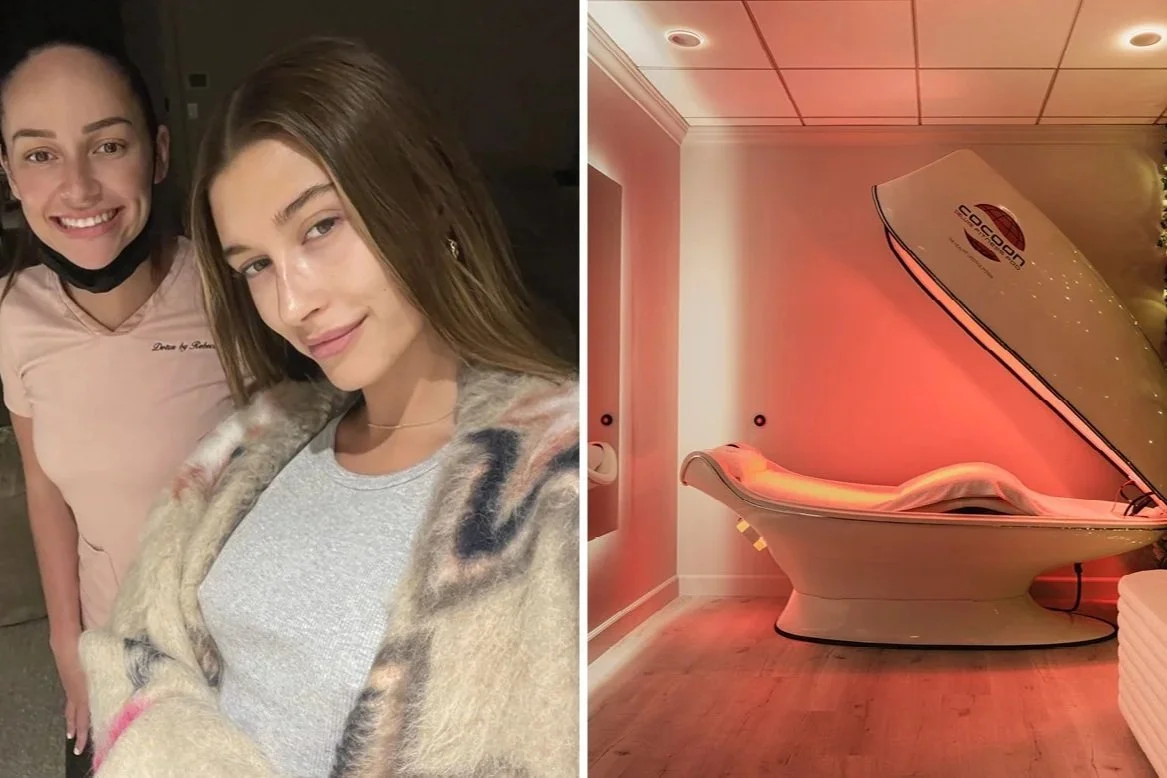

Celebrities aren’t doing lymphatic drainage, red light, facial sculpting, microcurrent, or bodywork just because it’s trendy. Sure, they get to post about it and maybe get the odd brand deal, but they’re ultimately doing it because these treatments enhance the foundations that everything else relies on: good circulation, efficient lymphatic flow, healthy fascia, stable hormones, responsive muscles, regulated stress. When these systems are firing, everything looks—and feels—better, too.
What are they doing?
Take Hailey Bieber; one of the faces we see a lot of online, and who has very recently shared her preferred treatment stack on a podcast. She shared she had skipped Botox for now, but relies on skin-regenerative treatments: microneedling with PRP, and PRF (both use a patient's own blood to promote healing and rejuvenation naturally within the skin), careful barrier work through skincare, lifestyle choices, NAD via IV, and she routinely sees celebrity favoured Rebecca Faria for lymphatic therapies and red light treatments (more on this later, but I just have completed lymphatic training with the famous ‘Detox by Rebecca’, and cannot wait to share it with you). Undeniably; she has impeccable skin.
Jennifer Aniston has famously turned away from drastic interventions. Her routine favours radiance-boosting therapies: microcurrent, infrared, targeted facials using collagen inducing and texture refining lasers, and compression therapy (PS: you can add on compression boots to any of my facials) to support tone and circulation. She is also the face of Pvolve workouts; a functional strength training gym and app, with the body to prove it.

Gwyneth Paltrow’s beauty approach has always blurred the boundaries between wellness and aesthetics: red-light therapy, gentle skin resurfacing, consistent anti-inflammatory care, and a holistic lifestyle that emphasises internal balance and regulation. A less is more approach, but one that is biologically strategic and was well before it’s time.
What they, and others like them, have in common isn’t a ‘look’. It’s a method. A method that primes the body to function optimally: good circulation, healthy lymphatic flow, responsive skin, eased inflammation, collagen encouragement, structural support. They’re working with their biology, not against it.
Why this matters and why it feels different now, is because it taps into something fundamental: longevity. Luxury used to be about what you showed off. Now it’s increasingly about what you preserve. This kind of glow doesn’t come overnight. It comes from months (sometimes years) of internal upkeep — hydration, sleep, stress regulation, layered with intelligent interventions. It leaves people with the indefinable glow of someone who has both the time and know-how to invest in themselves.
And yes: it shows. On skin. On posture. In our presence.
What I love most is that these approaches are about tuning the instrument you already have. It’s the same principle as strength training: consistent, thoughtful effort leads to strong arms, shoulders that sit better, a body that feels strong and fluid, and healthy bones that will serve us for years to come.
Celebrities are showing us that ‘results’ aren’t just about radical change or erasing imperfection. They’re about supporting natural systems inside and out so the body and skin perform at their best. Because the stronger your foundation, the more options you’ll have. Ageing with intention, feeling confident, and deciding later (as a nod to my previous issue all about the rise of cosmetic surgery) what, if anything, you want to add or enhance in other ways.
Maybe this is the quietest, most empowering flex of all. I’m taking notes.
From My Desk This Week:
One product I’m loving: I recently purchased a handful of iS Clinical products for at home and in clinic use. If I may break the rules here, and share two products; the iS CLINICAL Warming Honey Cleanser and Sheald Recovery Balm have made the world of difference to my ‘not-quite-adjusted-to-the-weather’ skin. The cleanser gently exfoliates but with the addition of honey is very soothing; I am loving it to keep my skin feeling clear without stripping the barrier. And the Balm does what it says on the tin, but is full of ceramides, hyaluronic acid and vitamin E to deeply nourish the skin.
What I’m reading/listening to: This morning I listened to Ladies Who Launch with Rochelle Humes, where she spoke to Anastasia Soare, the original queen of brows, about how she turned a $5,000 investment into a $3 billion brow empire. Beyond the impressive numbers, what really struck me was her personal journey: the early challenges of securing investment, being underestimated, and having to self-fund and flip houses for years before anyone truly recognised the potential of her business. It’s a great example of how the beauty industry is too often underestimated, not due to lack of innovation or impact, but because it’s true value is frequently misunderstood in the world of venture capital and investment.
In the media: I’ve mentioned GLP‑1s briefly above, and they’re everywhere right now, but one article this week really made me pause. This article by the Cut explores these drugs, like Ozempic, and points out an often-overlooked side effect: dampening food cravings might also dull ‘desire’ more broadly. Not just sexual desire, but spontaneity, creativity, social connection, and our general enjoyment. An interesting take on the ‘trade-off’ - a slimmer body (and for many, incredibly powerful from a health perspective), yes, but maybe at the cost of some of life’s spark.
Small shift to try this week: I’ve been experimenting with a quick self-lymph massage in the mornings and evenings. Using the big 6 method; targeting the collarbone, upper neck, armpits, abdomen, groin, and behind the knees, you can manually assist your lymphatic system in draining toxins, reducing inflammation, and supporting overall health. It only takes a few minutes but really helps me feel more alert, supports digestion and water retention through lymphatic drainage, and helps feel a little more connected to my body. Highly recommend.
As always, I hope this helps us all navigate some popularised topics around ageing with intention and ease. I’d love to hear your questions or any topics you’d like me to break down in future newsletters, just reply to this email.
With grace,
Charlie x
PS: Please forward this email on to anyone you think might find it insightful. They can sign up here, and read past issues here.
*For any studies or references to support this newsletter please reach out.