Graceful #026 — Sun, SPF & Why It's Complicated

I find myself having a version of the same conversation almost daily, particularly at this time of year. Someone comes in for a treatment, we get talking about routine, and they mention (usually with a slight air of confession) that they've been trying to be better about SPF. Maybe they started wearing it more consistently daily last summer, or after a skin treatment of some kind. Maybe they read something about photoageing and it scared them into action, or they finally found an SPF from a Korean brand they like to wear. Which is great, genuinely. Consistent SPF is one of the single most impactful things you can do for your skin over a lifetime, and I will never stop saying so.
But then, almost in the same breath, they'll mention that they've been feeling a bit low over winter. Tired. Flat. Sleep a bit off. Mood not quite right. And this week (after a small preview of spring) I found myself wondering (as I increasingly do) whether in our very well-intentioned pursuit of sun protection, we've quietly swung too far the other way, and started treating sunlight itself as the enemy.
It isn't. And I think the conversation around SPF, sunlight, and vitamin D is a little more nuanced than the beauty industry sometimes leads us to believe. So this week, as the days get longer and we all emerge, a little blinking, into spring; let's talk about it properly.
The SPF case is still solid.Let's get that out of the way first.
UV radiation is the single biggest external driver of skin ageing (responsible for up to 80% of visible facial ageing) and over years of cumulative unprotected exposure, the effects compound significantly (more how we’re ageing). It breaks down collagen and elastin, drives pigmentation, and disrupts the skin barrier. UVA rays (present year-round, even on overcast days, even through glass) are the main culprit for the deep structural damage that shows up later. UVB is what burns, and what also, interestingly, triggers vitamin D synthesis. Both matter, and broad-spectrum SPF addresses both.
This isn't abstract for me: both my mother and my mother-in-law are, at this point, fairly regularly having things removed (from their bodies, their faces, their arms) as a result of years of unprotected sun exposure. Gardening, summers abroad, a generation that simply wasn't told to protect themselves. Watching that unfold is a reminder that skin damage and skin cancer do not discriminate based on where on the body it occurs, and they are not just cosmetic concerns. Melanoma is the most serious form of skin cancer in the UK, and up to 9 in 10 cases could be prevented by safer sun habits. That is a statistic worth sitting with.
So: daily SPF, yes. On the face, neck, chest, and hands: areas that age visibly and are often forgotten. In summer that can be on limbs and across more of the body; more on that later. But I also think smart, conscious sun exposure is part of the picture, which is where the UV index becomes a genuinely useful tool rather than just a number in the corner of your weather app.
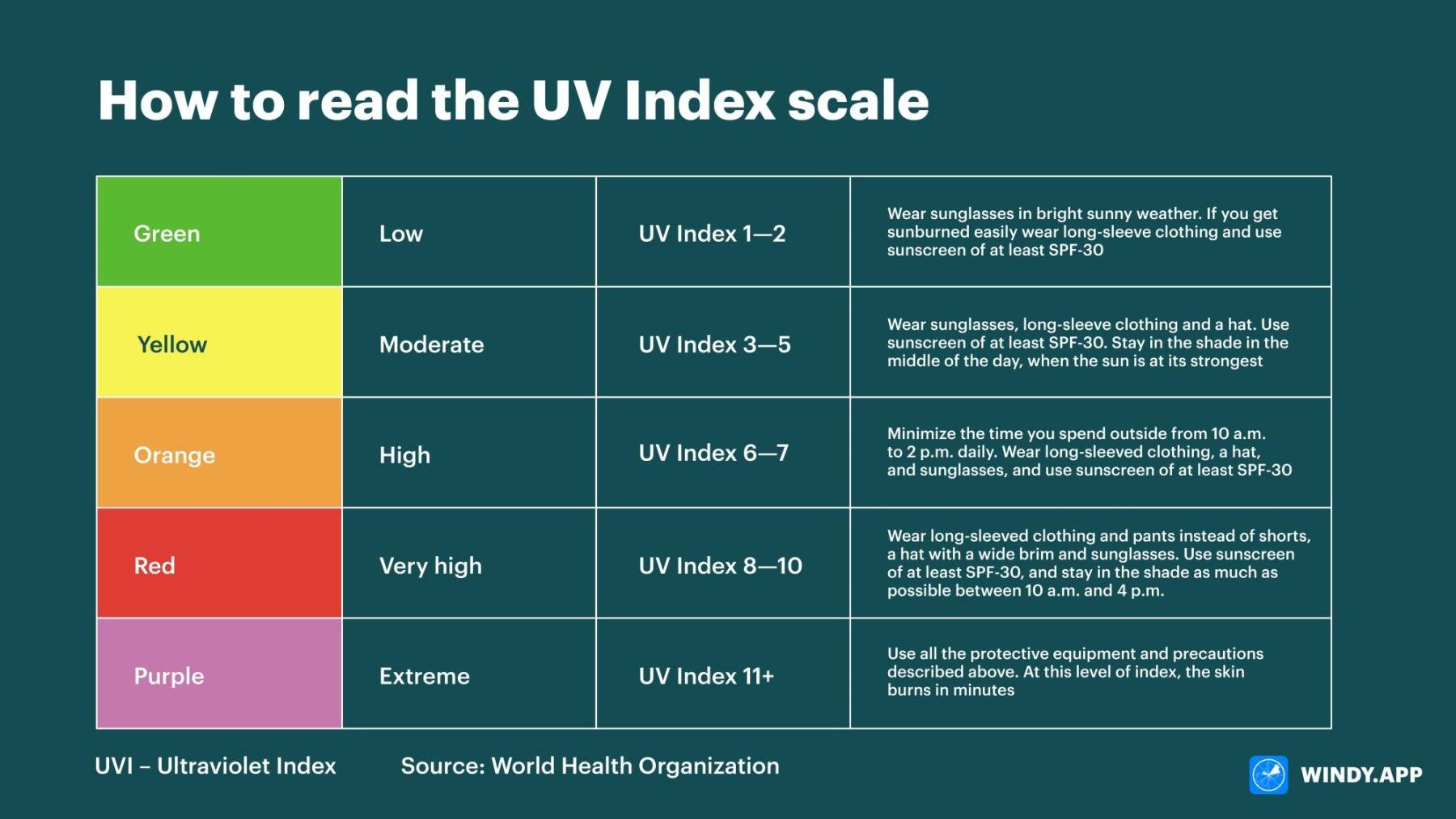
The UV index is an international scale that measures the strength of UV radiation at any given time and location. When the UV index is 3 or above, the sun is strong enough to cause damage, and sun protection is recommended. At 1–2, the risk is low.
In the UK, the index rarely exceeds 8, and in winter months it typically sits at 1 or 2; which is actually when you can safely get some direct sun exposure without meaningful damage risk. In spring and summer, particularly between 11am and 3pm, it rises significantly and protection matters. Checking the UV index daily (most weather apps show it) takes seconds and gives you real-time, genuinely useful guidance rather than a blanket rule applied in all conditions. On a January morning walk in London, a UV index of 1 means you're not doing damage; in July at midday, a UV index of 7 means you absolutely need protection. The nuance is in the number, and it removes all the guesswork.
The vitamin D situation in the UK is, frankly, not great…
Here's where I think we need to be honest. Almost half of adults in the UK have vitamin D levels below the optimal range, and women's average levels sit just at the lower threshold of what's considered sufficient; not comfortably above it, but right at the edge. The NHS recommends everyone in the UK supplement through autumn and winter. But surveys suggest the majority of us aren't doing it consistently, and most of us aren't testing our levels at all.
Vitamin D is interesting because it behaves less like a vitamin and more like a hormone. It has receptors in almost every tissue in the body, and its influence extends well beyond bone health into immune function, mood regulation, cardiovascular health, and increasingly, skin health. A deficiency doesn't usually announce itself dramatically; it tends to show up as a kind of background low: tiredness that doesn't fully lift, a mood that's slightly flatter than usual, getting ill more often than feels normal. Easy to dismiss, easy to attribute to something else, but very much worth paying attention to.
And for those of us wearing SPF diligently every day (which is good, keep doing it) it's worth knowing that while sunscreen doesn't block vitamin D production entirely (real-world application is imperfect, and some UVB gets through), it does meaningfully reduce it.
But sunlight is more than just vitamin D
This is the part of the conversation I find genuinely fascinating and that I think gets lost when we reduce everything to SPF vs. sun damage. Sunlight is a full biological spectrum; and our bodies evolved to use different wavelengths of it for different purposes. It isn't just the UVB that matters.
Morning light exposure (even through clouds, even without direct sun) is one of the most powerful signals your body receives to set its circadian rhythm for the day (more about this here). It suppresses melatonin, raises cortisol at the right time, and starts a cascade of hormonal signalling that influences energy, sleep, mood and appetite regulation across the following 24 hours. This is why Andrew Huberman talks about morning sunlight almost obsessively (and why, irritating as it can feel to be told to go outside before you've had coffee, the science behind it is actually solid). Without that morning light signal (particularly relevant in UK winters, or for those of us who commute underground or work in windowless offices) sleep quality declines, mood drops, energy becomes more erratic, and our whole system functions less well.
Sunlight also directly supports serotonin production, which is why a sunny day genuinely does lift your mood rather than it being all in your head. There's a reason seasonal affective disorder is a real and clinically recognised condition, and why it affects a disproportionate number of people at northern latitudes. We are, biologically speaking, creatures of light, and treating all sun exposure as something to be defensively managed and minimised has some consequences.
So how do we actually hold both things at once?
The answer, I think, is the same nuance that runs through most of what we talk about in this newsletter: it isn't either/or.
Wear SPF daily. Broad-spectrum, minimum SPF 30 (ideally 50 on the face in the warmer months), applied generously, reapplied if you're outside for extended periods. Protect the skin from cumulative UV damage, especially on the face, neck and chest where ageing shows up most (and we’re using ingredients or treatments in these areas that increase susceptibility even more). That doesn't change.
And…get some actual sunlight on your body. Arms, legs, ideally in the morning or outside of peak UV hours, for somewhere between 10 and 20 minutes several times a week. Not burning, not sunbathing, just existing outdoors with some skin exposed. For most people, in the UK context, this is genuinely hard to do enough of to make a real dent in vitamin D levels; which is exactly why supplementation matters (full article on supplements here). Then, hopefully it goes without saying; higher UV, summer months, SPF application (and re-application every 2 hours as advised by most manufacturers) is important on any exposed areas.
Supplement vitamin D3 year-round in the UK —
not just in winter, despite the NHS guidance suggesting autumn and winter only. Our latitude and our largely indoor lives mean most of us are not making enough even in the summer months. The standard NHS recommendation is 400 IU daily, but many practitioners in this space, including Dr Rhonda Patrick; suggest that 1,000–2,000 IU daily is more appropriate for adults, particularly women, and more so again; those with melanin rich skin. Getting your levels tested first (and over time) via a simple, inexpensive blood test is the most sensible approach, because it removes the guesswork entirely. NHS offers this if you’re able to gently nudge your GP enough, or there are several options like Medichecks you can find online.
And what about SPF ingredients themselves?
Worth a brief mention, because the landscape is more nuanced than the mineral-vs-chemical debate sometimes suggests, and I'd rather give you a clear steer than add to the noise.
Mineral SPF (zinc oxide and titanium dioxide) is well-tolerated and a great choice for many people. But for those with deeper skin tones where white cast is a real issue, or those who simply won't wear it consistently because the texture doesn't work for them, it isn't the only answer, and that's worth mentioning + a well-worn SPF 30 beats an abandoned SPF 50 every time.
Some older chemical filters (oxybenzone and octinoxate) have had questions raised about them, worth knowing if you'd prefer to avoid them. The newer generation of chemical filters (Tinosorb and Uvinul) widely used in European and Korean formulations have no such question marks and tend to be far more cosmetically elegant (read: wears well under makeup and doesn’t feel sticky). If you've struggled to find an SPF you actually like, looking for these on the label is a good place to start or I have a selection here.
Most importantly: under-application is the most common issue across the board. A teaspoon for face and neck, and reapplication if you're outdoors for extended periods (most SPF manufacturers recommend every 2 hours). I like to do 3 finger lengths for face and neck, to be on the safe side.
The bottom line:
Daily SPF is non-negotiable. And so, I'd argue, is getting enough sunlight, enough vitamin D, and enough morning light exposure to support the biological systems that everything else depends on. These aren't competing ideas, they're complementary ones, and the distinction is really about how you engage with the sun rather than whether you do.
We've spent a generation being told the sun is the enemy of our skin. It can be, in excess and unprotected. But the pendulum has swung quite far, and I think the more interesting, more complete conversation is one that holds skin protection and biological need for light in the same frame, which is, perhaps, where the graceful approach to ageing, lives.
From My Desk This Week:
One product I'm loving: I'm going to cheat slightly this week and point you somewhere more useful than a single recommendation; because when it comes to SPF, one size genuinely does not fit all, and I'd rather help you find your one than tell you mine. I have a full roster of tried and tested SPFs on my ShopMy — a range of price points, skin types, and filter options covering mineral, chemical and hybrid formulas. If you've been meaning to upgrade or finally find one you'll actually wear consistently.
What I'm reading/listening to: If the vitamin D and sunlight science in this issue interests you, Dr Rhonda Patrick is genuinely one of the most credible voices in this space. She has been on countless podcasts if that is your media of choice talking all things vitamin D (one here) and is worth a listen for anyone who wants to go deeper without wading through academic papers themselves.
In the media: Boots released their 2026 Beauty & Wellness Trends Report this year (using data from over 17 million Advantage Card holders) and a few things caught my eye. 80% of people are now taking a preventative approach to their beauty routines, prioritising long-term consistent care over reactive fixes. Collagen sales are up 62% year on year! And perhaps most interesting of all: 40% of consumers now view wellness as an essential part of their beauty regime, with 84% saying they look better when they feel well. The lines between the two have well and truly dissolved, and honestly, about time.
Small shift to try this week: Get outside within an hour of waking up; even for 10 minutes, even if it's overcast. No sunglasses if you can manage it (you want the light reaching your eyes). It sounds simple, but done consistently it has a measurable effect on sleep quality, mood, and energy across the day. Spring is, genuinely, the perfect time to start.
As always, I hope this helps us all navigate some popularised topics around ageing with intention and ease. I’d love to hear your questions or any topics you’d like me to break down in future newsletters, just reply to this email.
With grace,
Charlie x
PS: Please forward this email on to anyone you think might find it insightful. They can sign up here, and read past issues here.
*For any studies or references to support this newsletter please reach out.